Why ChatGPT Ads are worth your attention now
ChatGPT now shows ads under its answers, matched to whatever the person is asking about. ChatGPT Ads are sponsored placements that appear beneath relevant AI-generated responses in ChatGPT. Unlike traditional search advertising, ads are matched to the context of a user’s conversation rather than individual keywords.
They went live in the UK on 6 June 2026, OpenAI’s first European market, and UK businesses got the self-serve Ads Manager a couple of weeks later.
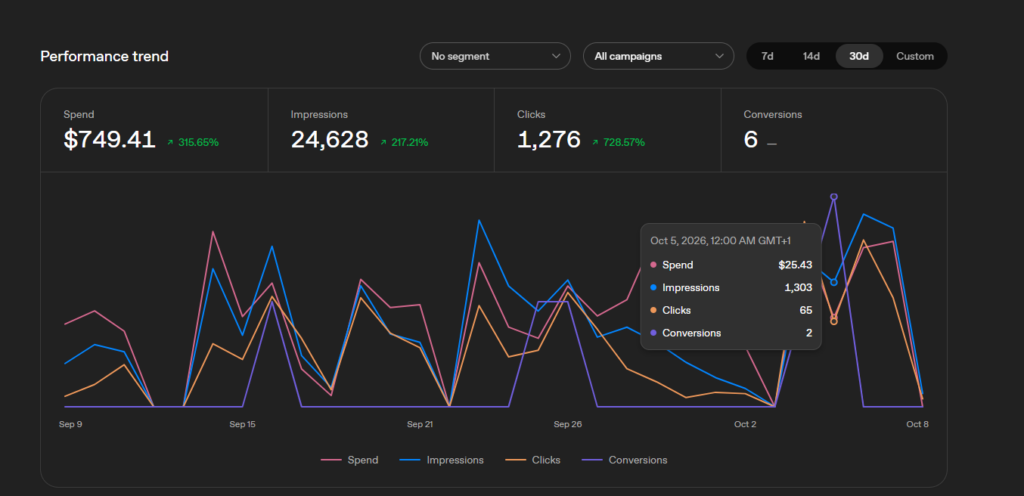
Treat this as more of a field report! We’ll cover what ChatGPT Ads are, what’s working for us, where they fit next to Google and social, and why GEO and SEO still decide whether you turn up in the answer itself.
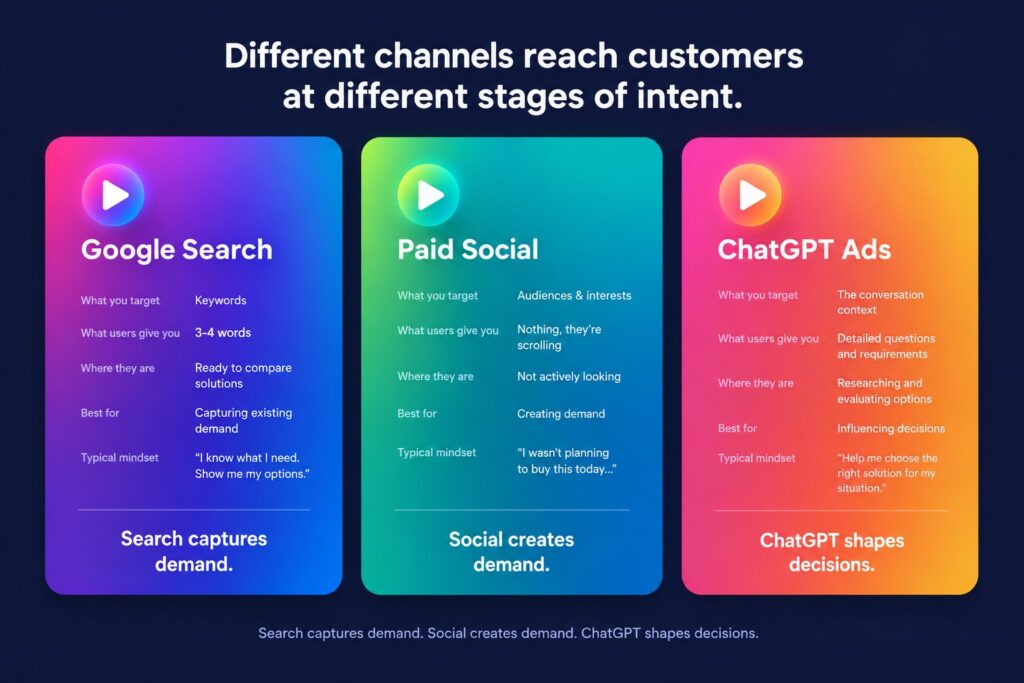
Search captures demand. Social creates demand. ChatGPT shapes decisions.
The customer journey is changing. Brands that appear only when people search risk missing the conversations that happen before intent exists.” Gemma Ross – Head of Paid Media
How ChatGPT Ads work, and why they’re different
On Google, people type three or four words. “Gym near me.” On Meta and TikTok we target who someone is and hope they want what we’re selling. In ChatGPT people talk properly, a whole paragraph or a voice note, so you learn far more about what they’re after.
Compare “gym near me” with “I’m 58, my knees aren’t great and I want to get fitter without making them worse. Where do I start?” Same person, maybe. Very different amount of information.
There are no keywords to bid on. You give OpenAI context hints, short descriptions of the conversations you want to appear next to. OpenAI says the system then weighs the current conversation, your landing page, title, copy, hints and targeting, plus wider ChatGPT history if the user has personalisation switched on. When several ads qualify, relevance and bid decide the order. You buy on CPM or CPC.
The ad sits below the answer, labelled as sponsored. It only shows to adults on the Free and Go plans, so Plus, Pro, Business and Enterprise users never see it. Advertisers get aggregated numbers like views and clicks, never the chats.
Google Search Ads Vs ChatGPT Ads
- User knows what they’re looking for
- Searches using keywords
- Ready to compare solutions
- Best at capturing existing demand
Paid Social Vs ChatGPT Ads
- User isn’t actively looking
- Based on interests and audiences
- Builds awareness and consideration
- Best at creating demand
ChatGPT Ads
- User asks detailed questions
- Gives context and requirements
- Evaluating options and researching
- Best at influencing decisions before purchase
8 Practical Lessons We’ve Learned from ChatGPT Ads
Tip – The ads that work sound like the next line of the conversation. Everything else follows from that.
1. Write ChatGPT Ads as if they are part of the conversation
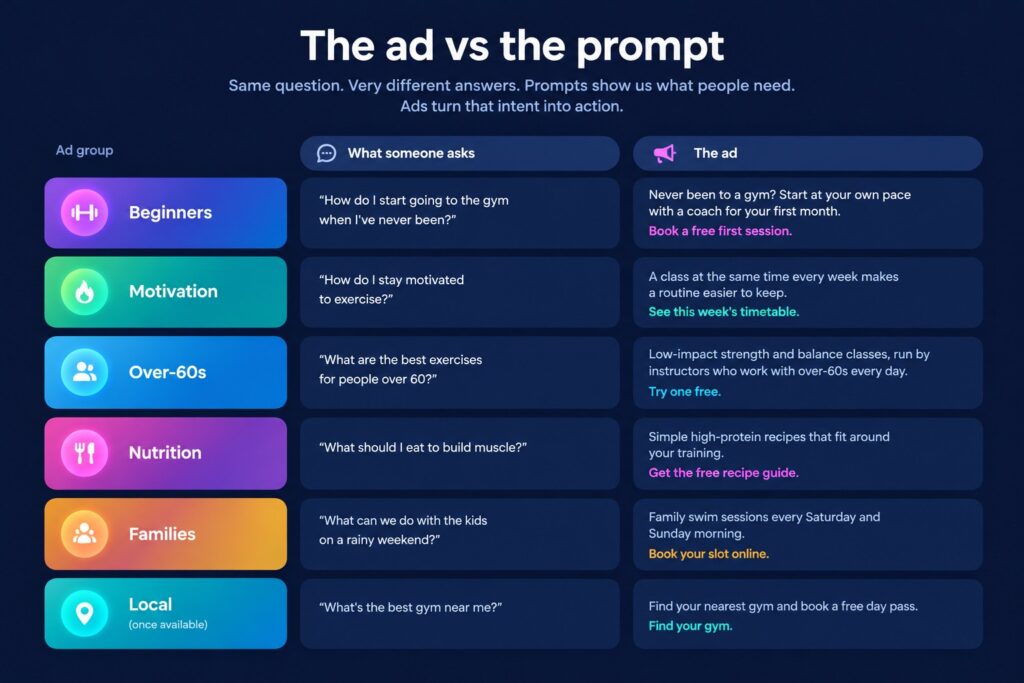
Someone has just asked a genuine question and received a useful answer. Your ad should feel like a natural continuation of that journey, not an interruption. An ad shouting about discounts can feel out of place. An ad that says, “New to the gym? Start at your own pace” feels helpful, relevant and timely.
2. Keep ChatGPT Ads creatives clear and simple
ChatGPT ads appear in a relatively compact format across desktop and mobile. Complex imagery, cluttered backgrounds and text-heavy graphics rarely work well. Instead, focus on one clear subject, strong visual contrast and imagery that supports the message without competing with it.
3. Match your landing page to the user’s intent
If someone has been asking questions about building muscle, send them to helpful content, recipes or a relevant product page. Don’t send them to the homepage and expect them to find their own way. Relevance matters at every stage, and a poor landing page can undermine both performance and conversion rates.
4. Structure ChatGPT Ad campaigns around intent, not products
The most effective ad groups are often built around the questions people are asking rather than the products you’re selling. Group users by intent, such as beginners, motivation, performance or healthy ageing, then tailor the messaging, context hints and landing pages accordingly. This also makes it much easier to identify which conversations are actually driving results.
5. Write contextual hints like a human, not with AI
Think less about keywords and more about real-world situations. “Someone who’s nervous about joining a gym for the first time” provides far more useful context than simply “gym membership”. You’re helping the platform understand the conversation you want to appear in, so describe the person and their circumstances as naturally as possible.
6. Get your ChatGPT tracking and UTMs sorted before you spend a penny
Before launching a campaign, make sure your pixel, analytics and conversion tracking are all in place. Clicks and traffic are easy to generate. Qualified leads and meaningful business outcomes are what matter. Given that ChatGPT often influences users during the research phase, the path to conversion can also be longer and less direct than traditional search advertising.
7. Give the new ads platform time to learn
Don’t judge performance after a week. Our own B2B testing took several months before we had enough data to understand which audiences, messages and conversations were generating the best results. The early stages are often about learning where your brand adds genuine value.
8. Learn from others’ mistakes
ChatGPT advertising is still new territory for most marketers. Working with an experienced Paid Media Agency can help you avoid costly mistakes, accelerate testing and uncover opportunities more quickly. At Bigwave, we’ve already spent time learning what works, what doesn’t and where businesses are most likely to see a return.
The biggest lesson from ChatGPT Ads so far
Treat ChatGPT ads less like traditional display advertising and more like joining a conversation. Brands that provide the right message at the right moment are far more likely to earn attention, trust and ultimately conversions.
Gemma Ross – Head of Paid Media
Targeting, budgets and who ChatGPT Ads suit right now
ChatGPT Ads are still in their early days, which means there are some limitations businesses need to be aware of before investing. Like any emerging channel, success comes from understanding where it fits within your wider marketing mix.
New platforms come with new risks. There are already examples of advertisers burning through their full lifetime budget in less than 24 hours. When issues occur, getting money back isn’t always quick or easy. In some cases, it can take months to reach a resolution. The lesson? Start small, monitor closely and don’t assume the safeguards are perfect just because the platform is new.
Currently best suited to national brands
Based on our testing so far, targeting appears to be UK-wide only, with a minimum daily budget of $25. That makes the platform far more accessible for national advertisers than businesses relying on local catchment areas.
Well worth testing for national B2B, ecommerce and membership brands
Businesses with longer consideration cycles tend to benefit most, particularly where customers spend time researching before making a purchase or enquiry. If your audience is asking questions before buying, there’s an opportunity to join those conversations.
Local businesses should start preparing now
Gyms, leisure centres, hospitality venues and other location-based brands may need to wait for more advanced local targeting. However, there’s no reason not to get the foundations in place today. Strong landing pages, audience insights and creative assets will all be valuable when the platform evolves.
Don’t neglect proven channels
If your Google Ads budget is already stretched, focus on the platforms where customers are actively looking to buy. ChatGPT Ads should complement an existing paid media strategy, not replace channels that are already delivering results.
Expect the platform to change quickly
New advertising formats, targeting options and measurement capabilities are being introduced at pace. What works today may look very different in six months’ time, so treat any guidance, including ours, as a snapshot rather than a rulebook.
Our advice? If your customers ask questions before they buy, ChatGPT Ads are worth exploring now. If they don’t, keep an eye on the platform, build your assets, and be ready to move when the targeting catches up with your audience.
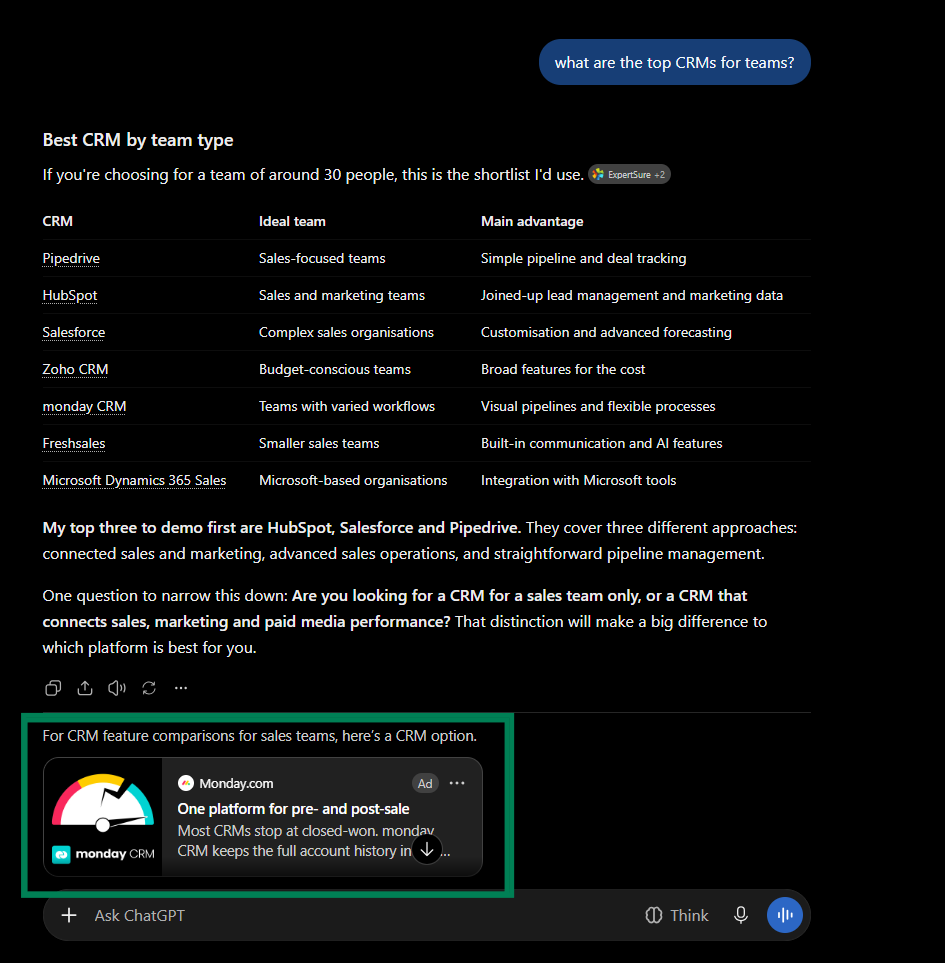
What does a helpful ad look like on ChatGPT?
Your ad appears only when it’s genuinely relevant to the ‘hint’ that the advertiser has written.
Unlike traditional display advertising, ChatGPT Ads don’t interrupt the experience. They appear after the user has received their answer, giving advertisers the opportunity to extend the conversation rather than distract from it.
Think of it as planting a seed. The user might click and take action immediately. They might remember your brand and mention it to a colleague a few days later. Or they may pick up their phone that evening and search for you directly. Customer journeys are rarely linear, especially during the research phase. That’s what makes ChatGPT Ads so interesting. While they help build familiarity and mental availability, we’ve also seen direct leads and conversions generated from the platform, proving that the right message in the right conversation can deliver both immediate and longer-term results. – Gemma Ross – Head of Paid Media.
In the example shown, the user is researching CRM platforms. After ChatGPT provides an impartial recommendation, a sponsored Monday CRM placement appears beneath the response. The ad is relevant to the topic, clearly labelled as sponsored, and gives the user an obvious next step if they want to explore their options further.
The key lesson for advertisers is simple: don’t think like a display advertiser, think like a helpful follow-up. The brands that perform best are likely to be the ones adding value to the conversation already taking place.
How to advertise on ChatGPT – a practical 90-day test plan
If you’re a national brand and want to try it, this is roughly how we’d run the first couple of months.
1. List the questions. Twenty or thirty real questions your customers ask before they buy. Sales calls, reviews and site search are good places to look.
2. Pick three or four themes. Turn the strongest questions into ad groups, each with its own context hints.
3. Build the landing pages. One per theme, each answering the question the ad picks up.
4. Set up tracking. Pixel or Conversions API, and an agreed definition of a good lead or sale.
5. Start sensibly, but don’t starve the test. You can get started from $25 per day per campaign, but if you’re serious about understanding whether ChatGPT Ads can work for your business, we’d suggest a test budget of £1,000-£5,000 over 30 days. Anything less can make it difficult to separate genuine insights from noise.
6. Review every fortnight. Cut the themes that bring clicks and no leads. Rewrite copy that sounds like an ad.
7. Decide at around three months. Permanent budget line, or back on the shelf until targeting improves.
We’re happy to talk it through if you’ve got a national brand that’s open to testing. Contact us here
ChatGPT Ads FAQs
How much do ChatGPT Ads cost?
ChatGPT Ads can be bought on either a CPM (cost per thousand impressions) or CPC (cost per click) basis. In our experience, the minimum budget in the UK is currently $25 per day, making it relatively affordable to test. As a newer advertising platform, CPCs are often higher than those seen in well-optimised Google Ads or Meta campaigns, but that’s fairly typical for an emerging channel.
Who sees ChatGPT Ads?
Ads are shown to adults using ChatGPT’s Free and Go plans. Users on Pro, Business, Enterprise and Edu plans don’t see ads, and neither do users identified as being under 18.
Do ChatGPT Ads influence ChatGPT’s answers?
No. Sponsored placements sit separately beneath the AI’s response and are clearly labelled as ads. Advertisers cannot influence, shape or rank the answers that ChatGPT provides.
Should I choose ChatGPT Ads or Google Ads?
If budget is limited, start with Google Ads. People searching on Google are often much closer to making a purchase or enquiry. ChatGPT Ads are best viewed as a complementary channel, helping brands engage potential customers while they’re still researching, comparing options or trying to understand the problem they’re looking to solve.
Can I target a specific local area?
Not currently, based on our experience. At the moment, ChatGPT Ads are best suited to national campaigns, although we expect more granular location targeting to be introduced as the platform develops.
Can advertisers see what people typed into ChatGPT?
No. Advertisers don’t have access to individual conversations or user prompts. Reporting is provided in aggregate, such as impressions, clicks and other campaign performance metrics.
What’s the difference between ChatGPT Ads and GEO?
ChatGPT Ads are paid placements that appear alongside AI-generated responses. GEO (Generative Engine Optimisation) is the process of improving your brand’s visibility within the AI’s answers themselves through high-quality content, strong website authority and third-party mentions. One is paid media; the other is organic visibility.
So, should you be thinking about ChatGPT Ads and GEO?
Probably.
Not because Google is disappearing. Not because ChatGPT is going to replace every other marketing channel overnight.
More and more people are turning to AI tools to help them compare options, answer questions and narrow down decisions. That’s creating two opportunities for brands: getting mentioned in the answer through GEO, and getting seen alongside the answer through ChatGPT Ads.
What’s different is the relationship people have with AI. They aren’t treating it like a traditional search engine. They’re speaking to it naturally, often using voice, asking follow-up questions, exploring ideas and treating it almost like a trusted advisor. For many users, AI is becoming the first place they turn when they need a recommendation, a second opinion, an explanation or help making a decision.
Whether that’s choosing a CRM, finding a gym, planning a holiday, selecting business software or researching a service provider, the behaviour is the same. People are asking AI the questions they would previously have asked a colleague, a friend or the internet as a whole. They’re looking for guidance, not just links.
That means being visible at this stage matters. A user might click and enquire immediately.
They might remember your brand and mention it to a colleague a few days later. They might see your name in a ChatGPT conversation and search for you on their phone later that evening. Or they may encounter your brand multiple times across AI, search and social before finally becoming a customer.
The journey is rarely linear, and that’s exactly why this space is so exciting. Brands now have the opportunity to influence decisions much earlier than they traditionally could. Not through interruption, but by being present during the moments people are learning, comparing and making sense of their options.
We’ve already seen direct leads and conversions from ChatGPT Ads. We’ve also seen first-hand how difficult it can be to attribute every touchpoint when AI becomes part of the research journey. What is clear, however, is that consumer behaviour is changing, and businesses that start learning now will be in a far stronger position than those waiting on the sidelines.
At Bigwave, we’re helping clients navigate exactly that shift. From SEO and GEO to PPC, Paid Social and emerging AI advertising platforms, our job is to make sure your brand shows up wherever your audience is looking for answers.
The technology may be changing, but the objective hasn’t. Be the brand people find, trust and remember when it matters most.
If you’d like to explore ChatGPT Ads, GEO, or what AI search means for your business, let’s have a chat.